
The Great Migration is one of those wildlife experiences that can stay with you long after you have returned home. Imagine standing on the open plains of Tanzania, watching thousands of wildebeest moving across the grasslands, their hooves raising dust beneath an enormous African sky. Somewhere nearby, zebras graze, birds circle overhead, and a lion rests in the shade of a rocky outcrop.
You may have travelled thousands of kilometres to witness this moment. Yet the most remarkable thing about the Serengeti is that nobody can tell you exactly what will happen next.
The herds might continue towards fresh grazing. They might gather along a riverbank. A predator might suddenly appear, or the animals might spend the afternoon grazing quietly while the light changes around them.
This unpredictability is part of the experience.
If you are researching how to plan a Serengeti Great Migration safari, understanding the seasonal movement of the animals is one of the most important steps towards planning a rewarding trip. The month you travel, the region you choose, the number of nights you spend in the park and the flexibility of your itinerary can all influence your experience.
At Nawahi Africa Adventures, we believe that a successful safari begins with understanding nature rather than expecting nature to follow a schedule. This guide explains what you need to know before planning your journey, from choosing the right season to selecting accommodation and making the most of your time in the Serengeti.
What Is the Serengeti Great Migration?
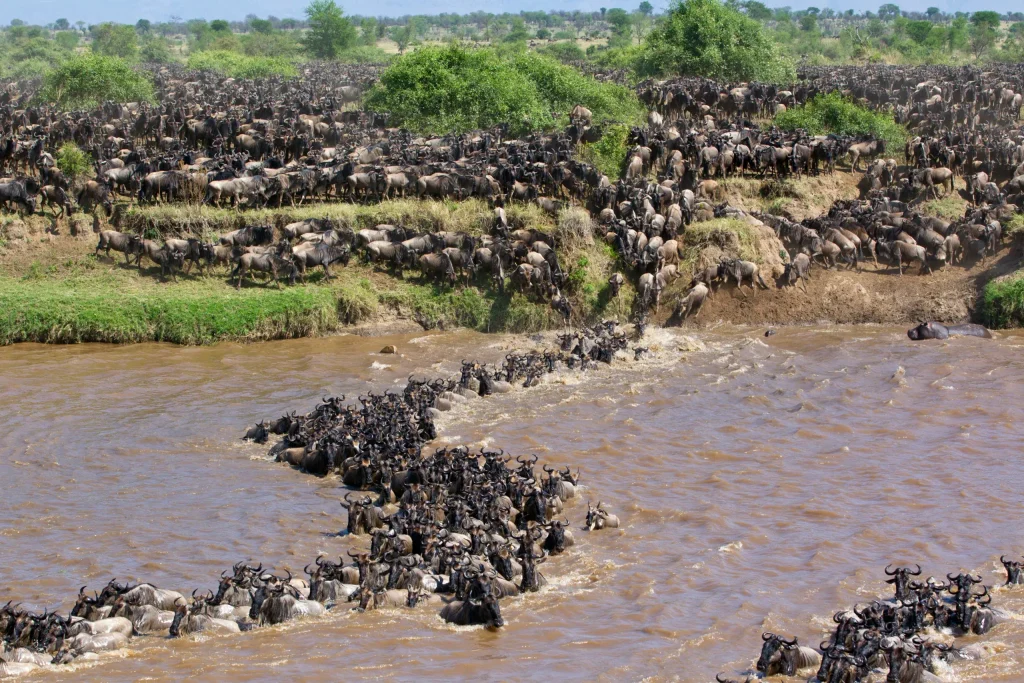
The Great Migration is the seasonal movement of large herds of wildebeest, accompanied by zebras and other grazing animals, across the Serengeti ecosystem in Tanzania and towards the Maasai Mara ecosystem in Kenya.
The movement is closely connected to rainfall and the availability of fresh grass. As conditions change, the herds travel across different parts of the ecosystem in search of suitable grazing and water.
Although the migration is often described as a single spectacular event, it is actually a continuous natural process. The animals do not all move together along one fixed route, and their distribution changes throughout the year.
At different times, visitors may find large herds on the southern plains, moving through the central and western Serengeti, or gathering in the northern region near the Mara River.
Each stage offers something different.
The southern plains are especially important during the calving season, when many wildebeest give birth. The western corridor provides opportunities to observe the herds moving through another part of the ecosystem. The northern Serengeti becomes particularly important for travellers hoping to witness the famous Mara River crossings.
The migration also supports a wider community of wildlife. Lions, cheetahs, hyenas, crocodiles and other predators interact with the changing distribution of prey, while vultures and other scavengers play their part in the ecosystem.
For visitors, this means the Great Migration is about more than counting wildebeest or waiting for a river crossing. It is an opportunity to understand how wildlife responds to the changing conditions of the African landscape.
How to Plan a Serengeti Great Migration Safari Around the Seasons
There is no single month that is perfect for every traveller. The right time depends on the wildlife experience you hope to see.
Some visitors want to witness newborn wildebeest and the activity of predators on the southern plains. Others dream of watching a herd approach the Mara River before suddenly plunging into the water.
These experiences occur in different regions and are associated with different periods of the year.
January to March: Wildebeest Calving Season
The southern Serengeti and the Ndutu area are particularly important during the early months of the year.
Following seasonal rainfall, the short-grass plains can provide favourable grazing conditions for large herds. Calving is a major feature of this period, with February commonly associated with a peak in wildebeest births, although the precise timing varies.
For wildlife enthusiasts, this can be an extraordinary time to visit.
You may see newborn calves learning to stand and walk, herds stretching across open grasslands, and predators searching for opportunities. Lions, cheetahs, hyenas and other carnivores form part of the natural cycle that unfolds around the herds.
Photographers often appreciate the open scenery and opportunities to observe animal behaviour against a broad landscape.
If your main interest is calving season, consider an itinerary focused on the southern Serengeti and Ndutu rather than choosing the northern Serengeti simply because it is associated with famous river crossings.
April to May: Green Landscapes and Seasonal Movement
April and May usually fall within Tanzania’s long-rains period.
The landscape can become greener, with dramatic clouds and fresh vegetation transforming the plains. During this period, herds begin moving towards other parts of the ecosystem as grazing conditions change.
These months can be rewarding for travellers who appreciate scenery, photography and a quieter atmosphere in suitable areas. However, heavy rain can affect road conditions, driving times and the operation of some accommodation facilities.
The migration may also be spread across different locations, so it is important to plan around the conditions expected for your dates.
If you are considering a safari during the green season, ask your tour operator about road accessibility, camp availability and realistic travel times. A carefully planned itinerary can help you enjoy the landscape without underestimating the practical challenges of travelling during rainy periods.
May to July: The Western Serengeti and Grumeti River
As the herds continue moving through the ecosystem, the Western Corridor becomes an important region to consider.
The Grumeti River is one of the natural obstacles encountered along parts of the migration route. Depending on the season and the movement of the herds, river crossings may occur in this region.
The western Serengeti offers a different perspective from the more widely publicised Mara River crossings. Travellers may encounter large herds moving through the landscape while also enjoying the area’s wider wildlife viewing opportunities.
The timing is not fixed, however. Seeing wildebeest in the western Serengeti does not guarantee that a crossing will occur during your stay.
For this reason, choose accommodation and an itinerary that make sense for the wider region rather than building your entire trip around one anticipated event.
July to October: Northern Serengeti and Mara River Crossings
For many international travellers, this is the most anticipated period of the migration calendar.
During these months, the northern Serengeti is an important area for herds moving towards the Mara River and the Maasai Mara ecosystem in Kenya.
Some herds gather near the river and attempt to cross. The sight of wildebeest entering the water, moving through strong currents and climbing the opposite bank can be unforgettable.
But there is a side of the experience that photographs rarely communicate: the waiting.
A herd may approach the river and remain there for hours. It may move away and return later, or cross at another location. Conditions can change quickly, and different groups of animals may behave differently.
July can bring opportunities for early crossings, while August and September are commonly popular months for travellers planning a northern Serengeti safari. Crossings may also occur in October, depending on rainfall and herd movement.
If witnessing a Mara River crossing is your main objective, prioritise the northern Serengeti during the relevant seasonal window. Staying in the central Serengeti and travelling long distances north each day may reduce the time available for wildlife viewing.
Allow several nights in the target region if your budget and schedule permit. This gives you more opportunities to explore the area and respond to changing conditions.
Remember that no tour operator can honestly guarantee a river crossing on a particular day.
November to December: The Journey Back South
The short rains commonly begin during November, although the timing and amount of rainfall vary.
As grazing conditions change, many herds begin moving southwards through the Serengeti. By December, some are returning towards the southern plains in preparation for the calving season.
These months can offer attractive green landscapes, changing skies and opportunities to observe wildlife in a different setting from the dry-season northern Serengeti.
They can be particularly appealing to travellers who want to experience the broader migration rather than concentrate entirely on river crossings.
As always, the actual location of the herds depends on conditions during that year. Check the likely migration area before deciding where to stay.
Which Part of the Serengeti Should You Visit?
Choosing the right region is just as important as choosing the right month.
The Serengeti is a vast ecosystem, and travel between its different regions can take considerable time. An itinerary that looks simple on a map may involve long drives, changing road conditions and fewer hours available for game viewing.
Southern Serengeti and Ndutu
Consider this region if your main interests are calving season, large herds and the behaviour of predators on open plains.
The southern plains are especially relevant during the early months of the year. Depending on the exact itinerary, travellers may explore areas around Ndutu and the wider southern Serengeti.
Ndutu lies near the boundary between the Serengeti National Park and the Ngorongoro Conservation Area, so it is important to confirm which areas and regulations apply to the accommodation and game drives included in your package.
Central Serengeti
The central Serengeti, including the Seronera area, is known for resident wildlife and opportunities to observe animals such as lions and leopards.
It can be a practical choice for itineraries that combine general wildlife viewing with migration experiences, depending on the season.
However, the central Serengeti is not automatically the best base for every stage of the migration. If your main goal is a northern river crossing, consider whether staying further north would give you more time in the relevant area.
Western Corridor
The Western Corridor is worth considering when the herds are moving through the western Serengeti.
It offers opportunities to explore another part of the migration route and may be relevant to travellers interested in the Grumeti River crossings.
Its suitability depends on your travel dates and the actual distribution of the herds.
Northern Serengeti
This region should be a priority for travellers planning around the Mara River crossing season.
Accommodation location matters because the distances between camps and potential wildlife-viewing areas can be substantial. Ask where the camp is situated, how game drives are organised and how much driving may be required to reach likely crossing areas.
The best camp is not necessarily the most expensive one. It is the one that fits your dates, budget and wildlife priorities.
How Many Days Do You Need for a Great Migration Safari?
The ideal duration depends on your budget, route and the experience you want.
A short safari can still be worthwhile, especially if you choose a suitable region and concentrate on the wildlife opportunities available there. However, a brief visit leaves less room to respond to changing herd movements.
For a migration-focused safari, several nights in the relevant region can be more useful than spending every day travelling between distant camps.
A five- to seven-day itinerary may allow travellers to combine the central and northern Serengeti during the river-crossing season, or focus on the southern plains during calving season. This is an example rather than a universal recommendation; travel times and available accommodation will determine what is practical.
Before confirming your itinerary, ask:
- How many nights will we spend in the main migration region?
- How much time will be spent travelling between camps?
- How many substantial game-drive periods are included?
- Can the itinerary be adjusted if wildlife conditions change?
- What wildlife experiences are available if a river crossing does not occur?
The aim is not simply to cover as much ground as possible. It is to spend enough time in the right places to enjoy the experience without turning the safari into a series of long transfers.
Choosing Accommodation for Your Serengeti Safari
Accommodation affects both comfort and wildlife-viewing opportunities.
The Serengeti offers a range of options, from simpler tented camps to luxury lodges. Your choice should reflect your budget, preferred level of comfort and the region you want to explore.
For a migration-focused trip, location deserves particular attention.
A luxury property far from your target wildlife area may require more driving than a simpler camp positioned conveniently for your intended game drives. On the other hand, travellers who value privacy, fine dining and additional facilities may find that a higher accommodation category is worth the cost.
When comparing options, consider:
- Location relative to your intended wildlife-viewing area.
- Accommodation category and room facilities.
- Meals and other included services.
- Park and conservation fees.
- Transfer arrangements and travel times.
- Seasonal availability and cancellation conditions.
Popular camps in the northern Serengeti can be in high demand during the river-crossing season. If your dates are fixed, planning ahead gives you more time to compare suitable properties.
How Much Does a Serengeti Great Migration Safari Cost?
There is no single price for a Great Migration safari. The final cost depends on the season, accommodation, transport, number of travellers and length of the itinerary.
Peak demand can affect the availability and cost of accommodation in popular migration areas. Private safaris may offer greater flexibility but generally have different per-person costs from shared arrangements.
Flights, road transfers and the location of your camp can also affect the total.
When requesting a quotation, ask for a clear breakdown covering:
- Accommodation and meals.
- Applicable park and conservation fees.
- Safari vehicle and guide services.
- Transfers and domestic flights, if required.
- Additional activities and requested services.
- Items that are excluded from the package.
Compare quotations on the basis of what they include, rather than choosing solely by the headline price.
If your budget is limited, discuss whether another migration season or a different accommodation category could provide better value. A carefully designed itinerary can be more satisfying than an expensive trip that spends too much time travelling between distant regions.
What If You Do Not See a River Crossing?
This is one of the most important questions to consider before booking.
Even during the usual crossing season, a river crossing is not guaranteed. The herds may remain near the river without crossing, move to another location or cross when you are elsewhere.
That does not mean your safari has failed.
The Serengeti supports a remarkable range of wildlife throughout the year. Lions, leopards, elephants, buffaloes, cheetahs, hyenas and numerous bird species provide opportunities for observation across different habitats.
You may watch a pride of lions resting beneath a tree, follow elephants moving through the grasslands or observe a cheetah scanning the plains. You might spend time with a large herd without seeing it cross a river.
These experiences are different from witnessing a dramatic crossing, and it is reasonable to recognise that distinction. If the crossing is your lifelong dream, plan accordingly and give yourself the best practical opportunity to see one.
At the same time, choose an itinerary that offers meaningful wildlife experiences beyond a single event.
Responsible Wildlife Viewing in the Serengeti
A memorable safari should also respect the animals and their environment.
During exciting sightings, visitors may want to get closer or stay longer for a photograph. However, wildlife viewing should follow park regulations and the guidance of qualified local guides.
Responsible viewing includes maintaining appropriate distances, avoiding unnecessary disturbance and never encouraging animals to behave in a particular way for photographs.
During a river crossing, vehicles should not interfere with the movement of the herd or obstruct the animals’ route.
The same principle applies when observing predators, newborn animals and other wildlife. Their natural behaviour should take priority over obtaining a photograph.
Choose a safari operator that treats responsible wildlife viewing as an essential part of the experience.
The Serengeti is not a stage designed for visitors. It is a living ecosystem, and part of travelling responsibly is accepting that nature determines what happens.
What Should You Pack for a Great Migration Safari?
Your packing list will depend on the season and the type of accommodation you choose, but several essentials are useful throughout the year.
Clothing: Bring comfortable, breathable clothes that can be layered. Neutral colours are practical for game drives, and a warm layer is useful during early mornings.
Sun protection: Pack a hat, sunglasses and sunscreen.
Binoculars: These can make a significant difference when observing animals at a distance.
Camera equipment: If photography is important to you, bring suitable lenses, spare batteries and enough storage. A protective bag can help keep dust away from your equipment.
Rain protection: During wetter months, a waterproof jacket and protection for electronics can be useful.
Personal essentials: Bring any necessary medication, insect repellent and other items appropriate to your travel plans.
Ask your operator about expected conditions before departure so that you can pack for the season without carrying unnecessary equipment.
Frequently Asked Questions About Planning a Serengeti Great Migration Safari
What is the best month to see the Great Migration in Tanzania?
The best month depends on your preferred experience. January to March is commonly associated with calving in the southern Serengeti and Ndutu area, while July to October is an important period for planning around northern Serengeti and Mara River crossings. Actual herd movements vary from year to year.
Are Mara River crossings guaranteed?
No. River crossings are natural events that depend on the behaviour of the herds and local conditions. Even when wildebeest gather near a river, they may wait, move elsewhere or cross at another location.
How many days should I spend on a Serengeti migration safari?
Several nights in the region most relevant to your travel dates can provide more flexibility than a short visit. A five- to seven-day itinerary may suit travellers who want to explore multiple areas, but the ideal duration depends on the route, budget and wildlife priorities.
Can I see the Great Migration outside July and August?
Yes. The migration continues throughout the year. Calving is a major feature of the southern plains early in the year, while the herds move through other parts of the Serengeti during different seasons.
Is February a good time to visit the Serengeti?
February is often a strong choice for travellers interested in calving season, newborn wildebeest and predator activity around the southern plains. It is a different experience from the northern river-crossing season.
Can I combine the Serengeti with Ngorongoro Crater?
Yes. Combining the Serengeti with the Ngorongoro Conservation Area can provide a varied northern Tanzania safari. The route should be planned carefully to allow sufficient time for your main migration objective.
Is a private safari worth the extra cost?
A private safari can offer more flexibility with departure times, game-drive duration and itinerary adjustments. However, it does not guarantee better wildlife sightings or a river crossing. Shared safaris may offer better value for travellers who are comfortable with a more structured arrangement.
When should I book my migration safari?
If your travel dates are fixed and you want accommodation in a specific region during the busy season, booking early is advisable. This gives you more time to compare accommodation and routes. The ideal booking lead time depends on your dates and preferred level of comfort.
Let Nature Set the Pace of Your Serengeti Safari
The Great Migration is remarkable because it follows the rhythms of the natural world, not because every day produces a dramatic spectacle.
One day, the plains may be filled with moving herds. Another day, the experience might be a quiet encounter with elephants, the sight of a newborn calf or the sound of birds calling across the grasslands.
A river crossing may become the highlight of your journey, but it is only one part of the wider story.
Planning your safari well means understanding the seasonal patterns, selecting a suitable region, allowing enough time and accepting that wildlife remains unpredictable.
At Nawahi Africa Adventures, we help travellers explore Tanzania with itineraries designed around their interests, travel dates and budget. Whether you are hoping to witness the Mara River crossings, experience the calving season or discover the wider wildlife of the Serengeti, thoughtful planning can help you make the most of your time in the wild.
We believe that honest advice is the beginning of a good safari. We will help you understand the opportunities available for your travel dates without promising a wildlife event that nobody can control.
Ready to plan your Serengeti Great Migration safari?
Visit Nawahi Africa Adventures to enquire about a tailor-made Tanzania safari. Tell us when you plan to travel, how many days you have and what you hope to experience. Together, we can explore an itinerary that fits your journey.
