
Imagine driving across the endless golden plains of Serengeti National Park just after sunrise. The air is cool, birds are calling from nearby acacia trees, and your safari guide suddenly slows the vehicle. Only a few meters away lies a magnificent male lion. His enormous mane glows in the morning light, yet instead of roaring or hunting, he barely opens one eye before stretching, yawning, and drifting back to sleep.
For many first-time safari visitors, the same question immediately comes to mind:
Why do lions sleep so much?
It seems strange that one of Africa’s most powerful predators spends most of its day sleeping. After all, lions are famous for hunting zebras, wildebeests, buffaloes, and other large animals. Shouldn’t the king of the savannah always be active?
The answer lies in millions of years of evolution. Lions are not lazy animals—they are energy-saving specialists. Every hour of rest helps prepare them for explosive bursts of speed, intense territorial defence, and cooperative hunting that can determine whether an entire pride survives.
Understanding why lions sleep so much also changes the way you experience a safari in Tanzania. What may look like an inactive lion is often an animal conserving energy for the most important hours of its day. The quiet lion you photograph in the afternoon could become one of Africa’s most efficient hunters after sunset.
In this guide, you’ll discover the fascinating science behind why lions sleep so much, how many hours they actually sleep, why male lions sleep more than females, and what these sleeping habits reveal about their extraordinary lives in Tanzania’s wilderness.
Are Lions Really Lazy?
One of the biggest misconceptions about African lions is that they are lazy. In reality, this belief comes from observing lions during the hottest hours of the day, when they are usually resting.
Unlike humans, lions do not follow a daytime work schedule. They have evolved to maximize survival, not activity. Every movement burns valuable energy, and replacing that energy requires successful hunting—something that is far from guaranteed in the wild.
A single hunt can involve stalking prey over long distances, waiting patiently in tall grass, sprinting at speeds of up to 80 km/h for a few seconds, wrestling powerful animals such as zebras or buffaloes, and sometimes defending the kill from hyenas or other lions. These activities consume enormous amounts of energy, making rest an essential part of a lion’s daily routine.
This is one of the main reasons why lions sleep so much. Sleeping is not a sign of laziness—it is a survival strategy that has helped lions remain one of Africa’s top predators for thousands of years.
In Tanzania’s vast ecosystems, especially the Serengeti, lions that waste energy unnecessarily are less likely to succeed during hunts. Every calorie matters, and every hour of rest increases the chances of surviving another day.
Nawahi Expert Insight
Many safari guests feel disappointed when they find lions sleeping instead of hunting. Experienced guides know better.
A sleeping lion is not a boring sight—it is an opportunity to observe natural behaviour. Watch carefully and you’ll notice pride members changing positions, grooming one another, flicking their tails to keep flies away, communicating through subtle sounds, and constantly scanning their surroundings even while resting. These quiet moments often reveal more about lion society than a dramatic chase lasting only a few seconds.
Why This Matters on Your Tanzania Safari
Knowing why lions sleep so much helps you plan a better safari.
Many visitors expect nonstop wildlife action throughout the day. However, experienced safari guides understand that lion behavior changes with temperature and time. Early morning and late afternoon game drives usually provide the best chance of seeing lions become active, while the hottest hours are ideal for observing fascinating social interactions within the pride.
This is why safari timing matters just as much as safari location. A knowledgeable guide doesn’t simply find lions—he knows when they are most likely to wake, move, communicate, or prepare for a hunt.
The Science Behind Their Extraordinary Sleeping Habits
How Many Hours Do Lions Sleep Every Day?
If you’ve ever returned from a morning game drive in Serengeti National Park and found the same lion sleeping in exactly the same place during your afternoon safari, you’re not imagining things. One of the most surprising facts about African lions is just how much time they spend asleep.
On average, adult lions sleep or rest between 16 and 20 hours every day, making them among the sleepiest land mammals on Earth. During exceptionally hot days, especially in Tanzania’s dry season, lions may remain inactive for even longer, conserving every possible calorie until conditions become more favorable for movement.
This astonishing sleeping pattern often surprises safari travelers because lions are known as fearless predators. However, the answer to why do lions sleep so much is rooted in biology rather than laziness. Unlike grazing animals that feed continuously throughout the day, lions rely on explosive hunting efforts that require enormous bursts of energy. Sleeping allows them to recover physically while reducing unnecessary energy loss.
Interestingly, lions do not spend all of these hours in deep sleep. Wildlife researchers have observed that much of a lion’s day consists of light resting, dozing, or quietly observing its surroundings. Even when their eyes appear closed, lions remain remarkably aware of nearby sounds, scents, and movements. A distant alarm call from an antelope or the roar of a neighbouring pride can instantly transform a seemingly sleepy lion into a fully alert predator.
Why Saving Energy Is the Secret to Survival
To understand why lions sleep so much, imagine trying to sprint at full speed while wrestling an opponent several times heavier than yourself. That is the reality of every lion hunt.
Unlike cheetahs, which rely on incredible speed, lions combine patience, teamwork, strength, and perfectly timed ambushes. Before launching an attack, they may spend hours quietly observing a herd, waiting for darkness or a moment of distraction. When the opportunity arrives, the chase is short but extremely demanding. Although lions can briefly reach speeds of around 80 km/h (50 mph), they can only maintain that speed for a few seconds before exhaustion sets in.
Because every hunt demands so much energy, lions have evolved to become masters of conservation. Every unnecessary movement reduces the energy available for hunting, defending territory, protecting cubs, or confronting rivals. This is one of the strongest scientific explanations for why lions sleep so much. Rest is not wasted time it is an investment in survival.
For lions living in Tanzania’s famous ecosystems, this strategy is especially important. In the Serengeti, prey animals migrate across vast distances throughout the year. In Ruaha National Park, prey can become scarce during the dry season. By sleeping and resting whenever hunting is unnecessary, lions increase their chances of surviving periods when food is difficult to find.
Why Do Male Lions Sleep More Than Female Lions?
One fascinating reason people ask why do lions sleep so much is because they notice that male lions often appear to sleep even more than females. Surprisingly, this observation is generally true.
Male lions frequently spend 18 to 20 hours resting each day, while lionesses tend to be more active because they carry most of the hunting responsibilities. A lioness may leave the pride before sunset to track prey, cooperate with other females during an ambush, nurse young cubs, or relocate the pride to a safer area. These daily responsibilities naturally require more movement than those of an adult male.
This does not mean male lions are lazy. Their role within the pride is very different. Adult males invest enormous amounts of energy defending territories that may stretch for hundreds of square kilometers. They regularly patrol boundaries, scent-mark vegetation, roar to warn neighboring males, and engage in dangerous fights that can determine the future of an entire pride. Conserving energy between these demanding events helps them remain physically prepared for sudden confrontations.
For safari travelers, this explains why a magnificent male lion is often found sleeping beneath an acacia tree while nearby lionesses remain alert or begin preparing for the evening hunt. Each member of the pride contributes differently to survival, and their sleeping patterns reflect those specialized roles.
Nawahi Expert Insight
Many guests laugh when they see a huge male lion asleep for hours, calling him “the laziest king in Africa.” In reality, experienced safari guides see something very different. A resting male lion is conserving the strength he may need later that night to defend his pride from rival males, chase away hyenas from a fresh kill, or respond to territorial challenges that could erupt without warning. Sometimes, the quietest lion during the day becomes the busiest lion after sunset.
Why Do Lions Sleep After Eating?
If you’ve ever watched a pride of lions after a successful hunt during a Tanzania safari, you may notice something surprising. After consuming an enormous meal, the lions rarely begin searching for more prey. Instead, they often walk only a short distance to a shaded area, lie down together, and spend many hours resting or sleeping.
So, why do lions sleep after eating?
The answer begins with the extraordinary size of a lion’s meal. An adult male lion can consume more than 30 kilograms (66 pounds) of meat in a single feeding when food is plentiful. That’s an enormous amount for the digestive system to process.
Digesting that much meat requires significant energy. Blood flow increases to the stomach and intestines, enzymes break down protein and fat, and the body begins storing nutrients that may need to last for several days if the next hunt is unsuccessful. Sleeping during this period helps lions conserve energy while allowing digestion to occur more efficiently.
This explains another reason why lions sleep so much. Their bodies are designed for a cycle of hunt, feast, rest, and repeat. Unlike grazing animals that eat small amounts throughout the day, lions experience long periods without food followed by very large meals. Resting after feeding is an essential part of that natural rhythm.
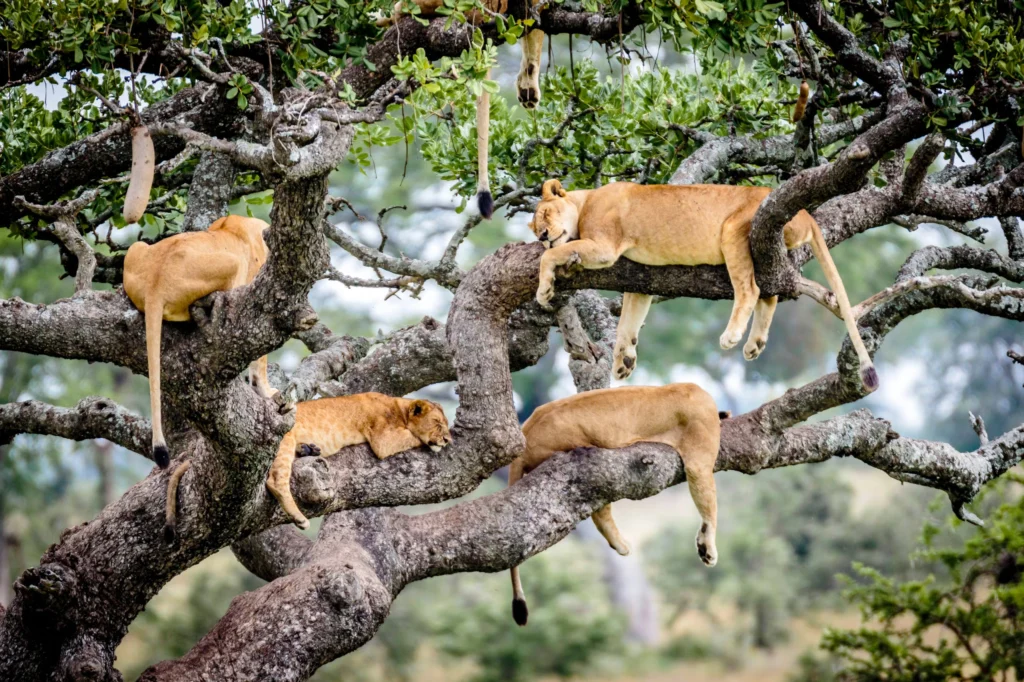
Why Do Lions Sleep Under Acacia Trees?
During a safari in Serengeti National Park, Tarangire National Park, or the Ngorongoro Conservation Area, you’ll often find lions sleeping beneath the broad canopy of an acacia tree rather than lying out in the open sun.
This isn’t a coincidence.
The African sun can raise ground temperatures to levels that quickly overheat a large predator. Adult male lions may weigh over 190 kilograms (420 pounds), and their thick mane absorbs even more heat. By choosing shaded areas beneath acacia trees, rocky outcrops known as kopjes, or patches of dense vegetation, lions reduce heat stress and conserve water.
Shade also offers another advantage—it provides a better position from which to observe their surroundings. Even while resting, lions can monitor the movements of prey animals, watch for approaching hyenas, and remain aware of rival prides entering their territory.
So when safari guests ask why do lions sleep under trees, the answer isn’t simply because it’s comfortable. It’s because shade improves survival.
Does Hot Weather Make Lions Sleep More?
Absolutely.
One of the biggest reasons why lions sleep so much in East Africa is temperature.
Most of Tanzania’s famous safari destinations experience intense daytime heat, especially during the dry season from June to October. Hunting under these conditions would waste valuable energy while increasing the risk of overheating.
Instead, lions have evolved to schedule their lives around the climate.
During the hottest part of the afternoon, they rest in the shade, minimizing movement and conserving energy. As temperatures begin to fall in the late afternoon and evening, they gradually become more active. This pattern allows them to hunt when conditions are cooler, prey animals are less alert, and the chances of success are much higher.
For safari travelers, this explains why early morning and late afternoon game drives consistently produce better lion sightings than the middle of the day.
Nawahi Safari Insight
Many guests think a sleeping lion means “nothing is happening.”
Experienced safari guides often think the opposite.
When lions suddenly move from deep shade into open grasslands during the late afternoon, guides recognize this as an important behavioral change. It’s often the first sign that the pride is preparing for the evening. They may begin stretching, grooming one another, scent-marking nearby bushes, or quietly walking toward areas where zebras, wildebeest, or buffalo are gathering.
For photographers, these moments are priceless. The golden light of the African sunset, combined with lions becoming active after hours of rest, creates some of the most dramatic wildlife photographs possible.
Myth vs Fact
| Myth | Fact |
|---|---|
| Lions sleep because they are lazy. | Lions sleep to conserve energy for hunting, defending territory, and surviving long periods between meals. |
| Lions can hunt effectively at any time of day. | Lions are generally far more successful when hunting during cooler hours, especially at night or around dawn and dusk. |
| A sleeping lion is unaware of its surroundings. | Even while resting, lions remain alert to sounds, scents, rival prides, and the alarm calls of prey animals. |
| Lions only sleep after eating. | Lions also sleep before hunts, during hot weather, and whenever conserving energy improves their chances of survival. |
Nawahi Expert Insight
One of the most common mistakes first-time safari visitors make is asking the guide to leave because “the lions are just sleeping.”
Professional guides know that patience often brings the greatest reward. A pride that appears completely inactive can suddenly wake, stretch, greet one another, and begin moving toward hunting grounds within minutes. Some of the most unforgettable safari moments happen just before lions become active—not after they already are.
Do Lions Dream? What Science Really Says
Have you ever watched a sleeping lion suddenly twitch its ears, move its paws, flick its tail, or make quiet sounds? These subtle movements often leave safari travelers wondering the same fascinating question: Do lions dream?
While no scientist can ask a lion what it dreams about, decades of research into mammalian sleep provide strong clues. Like humans, domestic cats, and many other mammals, lions experience different stages of sleep, including Rapid Eye Movement (REM) sleep. This stage is closely linked to dreaming, memory processing, and brain development.
During REM sleep, the brain remains highly active even though the body is largely relaxed. Researchers believe this helps animals process experiences from the day, strengthen memories, and improve learning. For lions, those experiences may include recognizing pride members, remembering hunting routes, identifying dangerous rivals, or learning the movements of prey animals.
Although nobody can say exactly what a lion dreams about, science suggests that sleep is doing far more than allowing muscles to recover. It is also helping the brain prepare for another day in one of the world’s most demanding environments.
Do Lion Cubs Sleep More Than Adult Lions?
Yes—and by a significant margin.
Newborn lion cubs spend most of their first weeks asleep, often resting for more than 20 hours each day. During this period, their bodies are growing rapidly, their immune systems are developing, and their brains are building the connections needed for survival.
As cubs grow older, they begin spending more time playing with their brothers and sisters. To an observer, these playful wrestling matches may simply look entertaining, but they serve an important purpose. Every chase, jump, pounce, and mock fight teaches future hunting techniques, improves coordination, and strengthens social bonds within the pride.
This combination of play and sleep allows young lions to develop into skilled predators capable of surviving the challenges of the African wilderness.
How the Great Migration Changes Lion Sleeping Patterns
One of Tanzania’s greatest wildlife spectacles also changes the daily routine of its most famous predator.
Each year, millions of wildebeest, zebras, and gazelles move across the Serengeti ecosystem during the Great Migration. As prey becomes more abundant, lions often adjust how they use their energy.
When food is plentiful, lions rarely need to travel long distances searching for prey. Instead, they can afford to spend more time resting between hunting opportunities. By conserving energy throughout the day, they remain ready to take advantage of herds that may pass nearby during the evening or throughout the night.
During seasons when prey becomes scarcer, lions may need to travel farther and remain active for longer periods before finding a successful kill. Their sleeping patterns therefore change according to food availability rather than following a fixed daily schedule.
This flexibility is another remarkable reason why lions sleep so much. Their behaviour constantly adapts to changing environmental conditions.
Why Safari Guides Predict Lion Activity Better Than Tourists
Many first-time safari visitors believe a sleeping lion means the excitement is over.
Experienced safari guides know the opposite is often true.
Professional guides rarely focus on whether a lion is asleep. Instead, they observe dozens of subtle behavioral clues that reveal what may happen next.
A lion lifting its head repeatedly.
A lioness quietly grooming another member of the pride.
A twitching tail.
Ears turning toward distant sounds.
The first members of the pride standing up to stretch.
The temperature beginning to cool.
Nearby zebras becoming increasingly alert.
Each of these small changes can signal that the pride is preparing to become active.
This is why experienced guides sometimes wait patiently with apparently sleeping lions while other vehicles drive away. Minutes later, those same lions may begin walking, greeting one another, roaring, or preparing for an evening hunt—creating unforgettable safari memories for the guests who stayed.
Still Curious? Your Lion Questions Answered
Why do lions sleep so much?
Lions sleep between 16 and 20 hours each day because hunting requires enormous bursts of energy. Sleeping helps them conserve calories, recover physically, and remain prepared to defend territory, protect cubs, and hunt successfully.
How many hours do lions sleep?
Adult lions typically sleep or rest for around 16–20 hours every day, although this varies depending on weather, food availability, age, and pride responsibilities.
Why do lions sleep during the day?
African afternoons are extremely hot. By resting during the hottest hours, lions avoid overheating and save energy for hunting during cooler periods, especially after sunset and before sunrise.
Why do male lions sleep more than females?
Lionesses perform most cooperative hunting, while adult males conserve energy for defending territory, protecting cubs, and confronting rival males.
Do lions sleep after eating?
Yes. After consuming large meals, lions often spend several hours resting while their bodies digest food and recover from the physical effort of hunting.
Are lions lazy?
No. Lions are highly efficient predators. Their long sleeping periods are an evolutionary adaptation that improves survival by conserving energy rather than wasting it.
When are lions most active?
Lions are generally most active during the cooler hours of the day, including early morning, late afternoon, evening, and throughout the night.
Where can I see lions in Tanzania?
Some of Tanzania’s best destinations for lion sightings include Serengeti National Park, Ngorongoro Conservation Area, Tarangire National Park, Ruaha National Park, Nyerere National Park, and Katavi National Park.
The Last Word: Why Every Sleeping Lion Has a Story
At first glance, a lion sleeping beneath an acacia tree may appear to be doing absolutely nothing. Yet every hour of rest is part of a carefully evolved survival strategy that has allowed lions to dominate Africa’s savannahs for thousands of years.
Sleeping is not a sign of laziness. It is a biological investment. Every period of rest helps lions conserve precious energy for the moments that truly matter—stalking prey across open grasslands, defending their pride against rivals, protecting vulnerable cubs, and surviving in an environment where every calorie counts.
Understanding why lions sleep so much changes the way you experience a safari. Instead of seeing an inactive animal, you begin to recognize the hidden rhythm of the African wilderness. You realize that today’s sleeping lion may become tonight’s hunter, protector, and king of the savannah.
The next time you encounter a pride resting peacefully under the shade of an acacia tree, don’t be disappointed. Pause, observe, and appreciate the remarkable science behind what appears to be a simple nap. In Africa, even a sleeping lion has a story worth telling.
Your Next Safari Starts with Curiosity
Every unforgettable safari begins with a question.
Why do lions sleep so much? Why do they roar at night? Why don’t they attack safari vehicles? The more you understand wildlife, the richer every game drive becomes.
At Nawahi Africa Adventures, we believe that the best safaris are built on curiosity, knowledge, and respect for nature. Our experienced guides don’t just help you find wildlife—they help you understand the fascinating behaviors that make Tanzania one of the world’s greatest safari destinations.
When you’re ready to witness these incredible moments for yourself, join us and discover the stories behind every roar, every footprint, and yes—even every sleeping lion.
